How do we use imaginary numbers ?
-We define the square root of -1 as "i". This is also called an imaginary unit.
-We call the 'i' solution to the equation ; i^2+1=0
Simplfying imaginary numbers example
What is the square root of -25 ?
- first notice that there shouldnt be any negative numbers under a radical , this means that there is no real solution , so your going to solve for the no solution.
so this will simplify to |25 and |-1
Now that 'i' is equivalent to the square root of -1 you can plug it in so the result will be 5i
What is the square root of -17?
this simplifies to |17 & |-1
now use 'i' in place of negative -1 and this becomes ; i|17
Notice that when the number is rational 'i' goes after the number and when the number is irrational the'i' goes before the number.
Note : there was no radical sign so I used "|" in place of it
Saturday, November 10, 2012

Tuesday, November 6, 2012
The discriminant (10/23/12)
How do we apply our quadratic knowledge to real world situations?
The quadratic equation :

Underneath the radical of the quadratic equation above, lies The Discriminant
B^2- 4ac
Rules of the discriminant :
b^2-4ac>0 - you'll get 2 solutions
b^2-4ac=0 - you'll get 1 solution
b^2-4ac<0 - you get 0 solutions
For example: x ^2 + 6x +9=0
label the letters to solve using the discriminant:
a=1
b=6
c=9
now plug it into the equation:
6^2-4(1)(-9) = 72
- referring back to the rules of the discriminant , the solution is greater than 0 so it has two solutions
-If b^2-4ac is a perfect square the two roots will be rational when you graph them
For example: x^2 +6x+8
a=1
b=6
c=8
plug into the formula : 6^2-4(1)(8)
the result is 4, since its a perfect square its rational
Next example: x^2 +3x-1
a=1
b=3
c=-1
plug into the formula :3^2-4(1)(-1)
this becomes: 9-4(1)(-1)
the result is 13 , since its not a perfect square its irrational
Cited works :
Let's be clear,http://paulpietrzak.blogspot.com/2011/01/solving-quadratic-equations-quadratic.html
The quadratic equation :

Underneath the radical of the quadratic equation above, lies The Discriminant
B^2- 4ac
Rules of the discriminant :
b^2-4ac>0 - you'll get 2 solutions
b^2-4ac=0 - you'll get 1 solution
b^2-4ac<0 - you get 0 solutions
For example: x ^2 + 6x +9=0
label the letters to solve using the discriminant:
a=1
b=6
c=9
now plug it into the equation:
6^2-4(1)(-9) = 72
- referring back to the rules of the discriminant , the solution is greater than 0 so it has two solutions
-If b^2-4ac is a perfect square the two roots will be rational when you graph them
For example: x^2 +6x+8
a=1
b=6
c=8
plug into the formula : 6^2-4(1)(8)
the result is 4, since its a perfect square its rational
Next example: x^2 +3x-1
a=1
b=3
c=-1
plug into the formula :3^2-4(1)(-1)
this becomes: 9-4(1)(-1)
the result is 13 , since its not a perfect square its irrational
Cited works :
Let's be clear,http://paulpietrzak.blogspot.com/2011/01/solving-quadratic-equations-quadratic.html
inverse of functions (10/3/12)
How do we calculate the inverse of functions?
- Two operations are said to be the inverse of each other if one of the operations undoes the other
-The inverse of f(x) can be calculated by swtiching the x & y values
For example : What is the inverse if f(x)=2x?
y=2x -------> x=2y
Then solve :
x/2=2y/2 ( the 2's on the right cancel out)
this then equals : x/2=y
- Using the inverse can also be applied to coordinates by switching the x & y as well
For example : What is the inverse of { (3,2)(-2,5)(6,0)}?
This equals : {(2,3)(5,-2)(0,6)}
- Two operations are said to be the inverse of each other if one of the operations undoes the other
-The inverse of f(x) can be calculated by swtiching the x & y values
For example : What is the inverse if f(x)=2x?
y=2x -------> x=2y
Then solve :
x/2=2y/2 ( the 2's on the right cancel out)
this then equals : x/2=y
- Using the inverse can also be applied to coordinates by switching the x & y as well
For example : What is the inverse of { (3,2)(-2,5)(6,0)}?
This equals : {(2,3)(5,-2)(0,6)}
Saturday, October 27, 2012
Quadratic equation
10/19/12
Aim: How do we solve quadratic equations?
Every parabola has an Axis of symmetry and a Vertex for example :

In order to determine the axis of symmetry , when given an equation you need to solve for (x).
- to solve for (x); use the equation (-b/2a)
Try this :
y=x^2 +6x+8
First label each of the variables to make it more clear :
a=1
b=6
c=8
Now you can use these numbers to solve for the axis of symmetry:
-6/2(1) ----> -6/3 = -2
The axis of symmetry/(x) = -2
Now using the (x) value you can solve for the vertex by plugging it into the equation
y=(-2)^2 + 6(-2)+8
y=0
This gives you the coordinate of the vertex : (-2,0)
Workcite
Northstarmath, http://www.northstarmath.com/sitemap/parabola.html
Aim: How do we solve quadratic equations?
Every parabola has an Axis of symmetry and a Vertex for example :
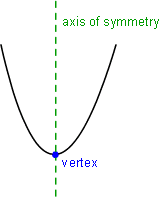
In order to determine the axis of symmetry , when given an equation you need to solve for (x).
- to solve for (x); use the equation (-b/2a)
Try this :
y=x^2 +6x+8
First label each of the variables to make it more clear :
a=1
b=6
c=8
Now you can use these numbers to solve for the axis of symmetry:
-6/2(1) ----> -6/3 = -2
The axis of symmetry/(x) = -2
Now using the (x) value you can solve for the vertex by plugging it into the equation
y=(-2)^2 + 6(-2)+8
y=0
This gives you the coordinate of the vertex : (-2,0)
Workcite
Northstarmath, http://www.northstarmath.com/sitemap/parabola.html
Sunday, May 6, 2012
5/3/12 How do we find the area of sectors and other parts of a circle?
How do we find the area of sectors and other parts of a circle?
Sector of a circle
- a sector of a circle is the region between the radii and the arc of a sector
To find the area of a sector : # of degrees /360 x (pi) r^2
Ex:

Segment of a circle
- a segment of a circle is the region between a chord and arc of circle
To find the area of the segment of a circle : # of degrees/360 x (pi)r^ - 1/2bh
Ex:

Annulus
- an annulus is the region between two concentric circles
To find the area of the annulus : (pi)R^2- (pi)r1
Ex:

Practice question : If radius 1 is 12 and radius 2 is 6, What is the area of the annulus?
Citations
- Problem solving , http://www.p12.nysed.gov/ciai/mst/math/sampletasks/Math6Sample.htm
- Chord and segment of a circle, http://www.winpossible.com/lessons/Chord_and_Segment_Of_A_Circle.aspx, 2011
- Annulus calculator , http://www.calculatorsoup.com/calculators/geometry-plane/annulus.php
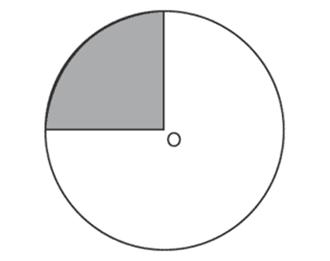
Sector of a circle
- a sector of a circle is the region between the radii and the arc of a sector
To find the area of a sector : # of degrees /360 x (pi) r^2
Ex:
Segment of a circle
- a segment of a circle is the region between a chord and arc of circle
To find the area of the segment of a circle : # of degrees/360 x (pi)r^ - 1/2bh
Ex:
Annulus
- an annulus is the region between two concentric circles
To find the area of the annulus : (pi)R^2- (pi)r1
Ex:
Practice question : If radius 1 is 12 and radius 2 is 6, What is the area of the annulus?
Citations
- Problem solving , http://www.p12.nysed.gov/ciai/mst/math/sampletasks/Math6Sample.htm
- Chord and segment of a circle, http://www.winpossible.com/lessons/Chord_and_Segment_Of_A_Circle.aspx, 2011
- Annulus calculator , http://www.calculatorsoup.com/calculators/geometry-plane/annulus.php
5/1/12 How do we use secant , chord and tangents in circles? ?
How do we use Secants, Chords and Tangents in circles?
Secant
- a line that cuts through or divides a curve into two or more parts
Ex:

Chord
- a straight line thats joins the ends of an arc
Ex :

Tangent
- straight line or plane that touches a curve or curved surface at a point
Ex:

Practice Question : What does the line TL image below represent?

Citations
- Chord , Wolfram MathWorld , http://mathworld.wolfram.com/Chord.html , 2012
- http://www.google.com/imgres?q=secant&start=173&um=1&hl=en&sa=N&biw=1280&bih=861&addh=36&tbm=isch&tbnid=Lo2YH7az3PTd1M:&imgrefurl=https://internal.shenton.wa.edu.au/maths/WestOne3CMAS/content/004_functions/media/glossary.html&docid=r1W_zcdlQ_KVDM&imgurl=https://internal.shenton.wa.edu.au/maths/WestOne3CMAS/content/004_functions/media/images/glossary_secant.gif&w=290&h=250&ei=QcymT8myJqGJ6QGyiaCdBA&zoom=1&iact=hc&vpx=606&vpy=126&dur=282&hovh=179&hovw=216&tx=126&ty=147&sig=100793830460579110965&page=8&tbnh=152&tbnw=195&ndsp=25&ved=1t:429,r:7,s:173,i:194
- Chapter 9: Chords and Arcs, http://whites-geometry-wiki.wikispaces.com/PETO626
- Geometry : Circles , http://www.sparknotes.com/math/geometry1/circles/section3.rhtml , 2012
Secant
- a line that cuts through or divides a curve into two or more parts
Ex:

Chord
- a straight line thats joins the ends of an arc
Ex :
Tangent
- straight line or plane that touches a curve or curved surface at a point
Ex:

Practice Question : What does the line TL image below represent?
Citations
- Chord , Wolfram MathWorld , http://mathworld.wolfram.com/Chord.html , 2012
- http://www.google.com/imgres?q=secant&start=173&um=1&hl=en&sa=N&biw=1280&bih=861&addh=36&tbm=isch&tbnid=Lo2YH7az3PTd1M:&imgrefurl=https://internal.shenton.wa.edu.au/maths/WestOne3CMAS/content/004_functions/media/glossary.html&docid=r1W_zcdlQ_KVDM&imgurl=https://internal.shenton.wa.edu.au/maths/WestOne3CMAS/content/004_functions/media/images/glossary_secant.gif&w=290&h=250&ei=QcymT8myJqGJ6QGyiaCdBA&zoom=1&iact=hc&vpx=606&vpy=126&dur=282&hovh=179&hovw=216&tx=126&ty=147&sig=100793830460579110965&page=8&tbnh=152&tbnw=195&ndsp=25&ved=1t:429,r:7,s:173,i:194
- Chapter 9: Chords and Arcs, http://whites-geometry-wiki.wikispaces.com/PETO626
- Geometry : Circles , http://www.sparknotes.com/math/geometry1/circles/section3.rhtml , 2012
How do we review transformations?
Isometry
- length is preserved
- sides are congruents ( like their reflecting)
Ex:

Direct isometry
- orientation is preserved( stays the same)
- The order of the lettering in the figure and the images are the same
- either clockwise becomes counter clockwise or counter clockwise becomes clockwise
- every translation and rotation is a direct isometry
Ex:

Opposite isometry
- orientation isn't preserved (changes)
- the order of the lettering is reversed
- every reflection and glide reflection is an opposite isometry
Ex:

Same orientation :
rorgin (x,y) -> (-x,-y)
R90 (x,y) -> (-y,x)
R180 ( x,y)-> (-x,-y)
R270 ( x,y) -> ( y,-x)
Reversed orientation:
r- x-axis (x,y) -> ( x,-y)
r-y-axis (x,y) ->(-x,y)
ry = x (x,y) -> ( y,x)
ry = -x (x,y) -> (-y,-x)
Practice question : What is the difference between a direct and opposite isometry?
Practice question : What is the difference between a direct and opposite isometry?
Citations
- http://zsolania.blogspot.com/
- Haskell , Kenn, Functional Lens , http://www.kennknowles.com/blog/2007/12/03/calculating-the-reflect-rotate-translate-normal-form-for-an-isometry-of-the-plane-in-haskell-and-verifying-it-with-quickcheck/
Subscribe to:
Posts (Atom)